Francis Fukuyama End Of History
Books The End of History and the Last Man by Francis Fukuyama David Macintosh reaches The End of History. Francis Fukuyama is a conservative political philosopher and economist. He was politically active during the Reagan administration, when he worked for the State Department, and also during the Clinton years, mainly through Washington think tanks. During the earlier years, Fukuyama was interested in US foreign policy, later becoming increasingly interested in broader, long-term political goals in the hope of providing solutions to problems on a global scale. He wrote The End of History and the Last Man in 1992 as an attempt to solve some of these problems.
His contention in this book is that liberal democracy is the final form of government for the world, and the end of human ideological struggle. The History of The End of History The core of the book came from a paper written by Fukuyama in 1989 entitled ‘The End of History’. In it Fukuyama noted that Western liberal democratic traditions have maintained their place in politics over the last hundred years despite the successive rise of alternative systems of government: liberal democratic government has outlasted monarchism, fascism and communism.

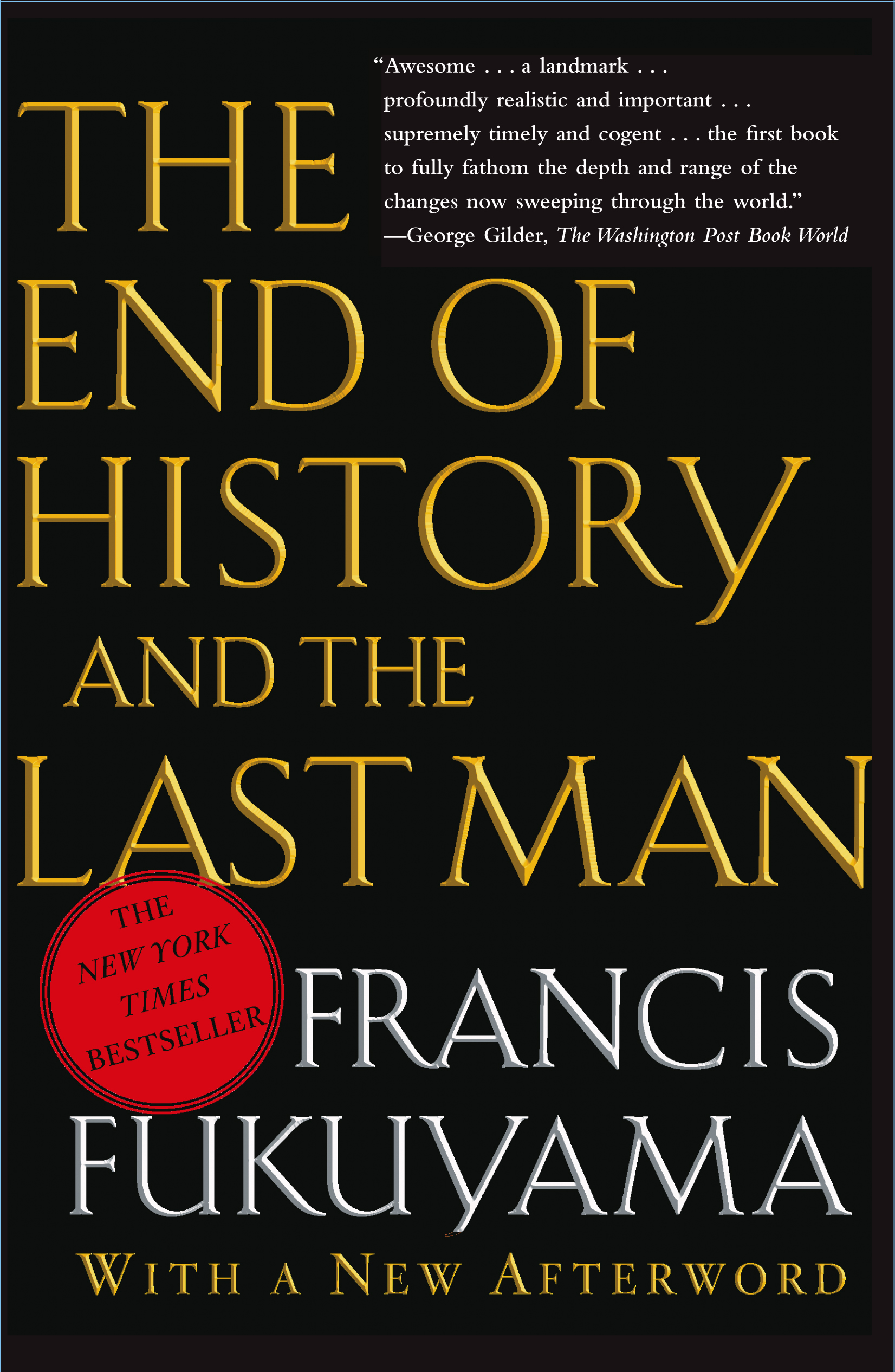
Motorola Symbol Scanner N410 Manual. Yoshihiro Francis Fukuyama (born October 27, 1952) is an American political scientist, political economist, and author. Fire Emblem Souen No Kiseki Iso. Fukuyama is known for his book The End of History and the Last Man (1992), which argued that the worldwide spread of liberal democracies and free market capitalism of the West and its lifestyle may signal the end point of. The End of History and the Last Man [Francis Fukuyama] on Amazon.com. *FREE* shipping on qualifying offers. Ever since its first publication in 1992, The End of History and the Last Man has provoked controversy and debate.
In fact, it can be said that liberal democracy has survived to increasingly become the choice of political system for all nations. Fukuyama’s central thesis in The End of History and the Last Man is that human history is moving towards a state of idealised harmony through the mechanisms of liberal democracy.
For Fukuyama, the realization of an ideal political and economic system which has the essential elements of liberal democracy is the purpose behind the march of history. ‘Liberal democracy’ does not necessarily mean the exact type of constitutional democracy found in the United States. It can manifest itself in a number of ways, but its consistent features are freedom of speech, free and fair elections, and the separation of powers. Fukuyama argues that there are no ‘contradictions in human life’ that cannot be resolved within the context of liberalism; or more generally, that there is no longer an alternative political and economic structure that can offer solutions to problems such as the need for freedom, protection, and human rights. Free market capitalism in action Market pic © Sick-o-bot 2012 In making his claim about history having a process and a goal, Fukuyama is following in the footsteps of the early Nineteenth Century German philosopher Georg Hegel (1770-1831). This famous philosopher saw a ‘dialectical’ process as the driving force behind human history that will eventually achieve a final goal for humanity. This Hegelian dialectic is a logical process manifest in the events of history and unfolding over time.